Employee Expense Report Sheet to HR
Organizations typically have a reimbursement policy under which they repay employees for out-of-pocket expenses incurred for official purposes or eligible benefits, such as medical expenses. To ensure consistency and standardization in how employees request reimbursements, organizations use an Employee Expense Report Sheet.
An Employee Expense Report Sheet is a form designed by an organization, either created in-house or customized from a ready-made template. Employees use this sheet to request reimbursement for expenses they have personally paid while performing official duties or claiming other eligible benefits.
The completed sheet is submitted along with supporting receipts as proof of payment. This helps ensure transparency, accuracy, and minimizes the risk of errors or fraudulent claims. In short, this document serves as a formal record of employee-incurred expenses and a request for reimbursement.
Before exploring the benefits, it is important to understand why organizations rely on an Employee Expense Report Sheet in their daily operations. Managing employee expenses without a proper system can lead to confusion, delays, and inaccuracies in reimbursements. A well-structured expense report sheet brings clarity to the process by organizing all relevant details in one place, making it easier for both employees and management to track, verify, and approve expenses efficiently.
Benefits of an Employee Expense Report Sheet
The following are some key advantages of using an employee expense report sheet:
1. Clear Overview of Employee Reimbursements
This sheet provides a well-organized summary of reimbursement requests submitted by employees. It allows organizations to quickly review total claims, monitor spending patterns, and make informed financial decisions.
2. Standardized Reporting and Reduced Errors
Using a consistent format ensures that all employees submit their expense details in the same way. This standardization simplifies the review process, speeds up approvals, and reduces confusion. In digital formats, built-in formulas further help minimize calculation errors.
3. Ensures Compliance with Spending Limits
Organizations often define limits for different expense categories. This sheet helps management verify whether submitted claims fall within approved limits and make adjustments if necessary.
4. Supports Analysis and Cost Optimization
Expense reports enable management to analyze spending trends and identify opportunities to reduce costs. For instance, frequent high hotel expenses during business travel may encourage organizations to negotiate corporate rates or establish partnerships with specific vendors.
To make the most of an Employee Expense Report Sheet, it is essential to understand the key elements that make it effective and easy to use. Each section of the sheet plays a specific role in capturing accurate information, ensuring proper documentation, and supporting a smooth approval process. By including all necessary components, organizations can maintain consistency, improve transparency, and simplify expense tracking and reimbursement procedures.
Key Components of an Employee Expense Report Sheet
Organizations may customize the sheet based on their policies, expense types, and audit requirements. However, most Employee Expense Report Sheets include the following components:
1. Basic Information
- Date
- Reporting period (time covered)
- Employee name
- Employee ID
- Department
- Reporting manager’s name
- Purpose of the report
2. Expense Details
- Expense category/type
- Description of expense
- Fields for additional or unusual expenses
- Amount
3. Totals and Adjustments
- Gross total of expenses
- Advance received (if any)
- Net reimbursement amount
4. Additional Information
- Notes or remarks (if any)
- Disclaimer or declaration statement
5. Authorization Section
- Employee signature
- Manager approval
- HR/Finance approval (if applicable)
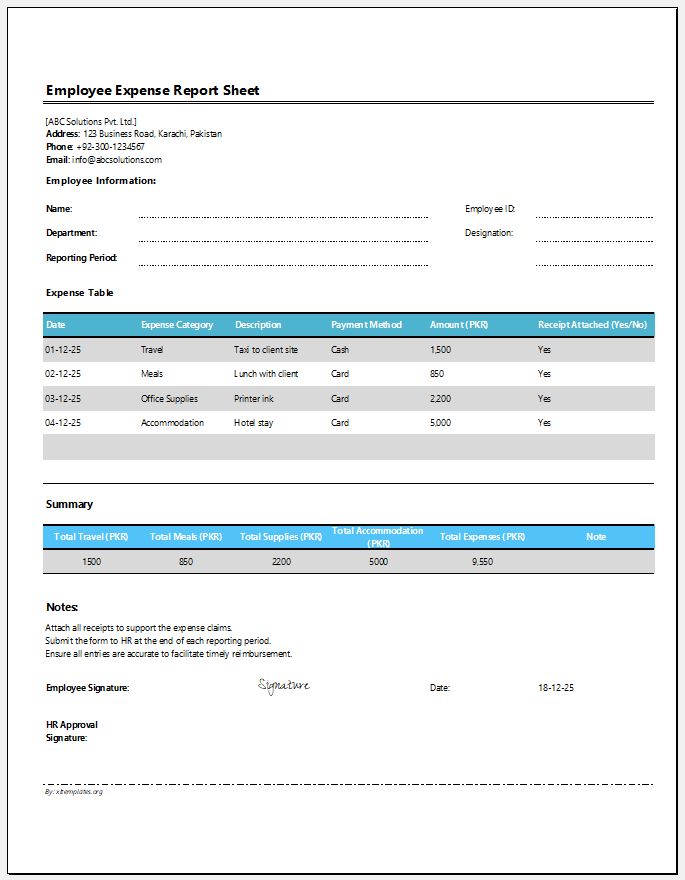
After understanding the structure and essential components of an Employee Expense Report Sheet, it is helpful to see how all these elements come together in a practical format. A well-designed template not only organizes information efficiently but also makes it easier for employees to fill out and for management to review and approve. The following preview gives you a clear idea of how a complete and user-friendly expense report sheet looks in practice.
Preview of Template
You can use a professionally designed Employee Expense Report Sheet template to simplify the reimbursement process. Such templates are easy to customize, include built-in calculations, and are ready for immediate use. They help organizations maintain accuracy, save time, and ensure a smooth approval workflow.
(Preview)
File Size: 162 KB
See also:
- 1 to 10 Multiplication Table for Kids
- 18 Period Budget Template
- 401K Calculator Template
- 7 Day Schedule Worksheet Template
- Academic Activity Budget Worksheet
- Academic Activity Budget Worksheet
- Address List or Address Book
- Adjustable vs Fixed Rate Mortgage Comparison Worksheet
- Advance Payment Invoice
- Allergy Trigger and Symptom Table
- Allowance Tracker Template
- Annual Dinner Budget Worksheet
- Annual Profit Budget Sheet
- Annuity Investment Calculator
- Annuity Payout Calculator
← Previous Article
End-of-Day Cash-up SheetNext Article →
Vehicle Mileage & Fuel Log Sheet