Credit Card Log Template
It is not always necessary to have physical cash in hand to manage daily expenses. Credit cards have made financial transactions significantly easier by allowing users to spend or borrow money from their bank even when they do not have immediate cash available.
Most banks provide a grace period of 25–30 days to repay the borrowed amount. If the full balance is paid within this time, no additional interest is charged, making credit cards a convenient short-term financial tool. This grace period also provides users with short-term financial flexibility to manage their expenses without immediate pressure. However, it is important to keep track of spending during this period to ensure the balance remains within a manageable limit. Proper monitoring helps avoid unexpected debt and interest charges later on.
With this basic feature in mind, it becomes clear that credit cards are more than just a payment method -they are financial tools that can either improve or complicate a person’s financial life depending on how they are used. While they offer convenience and short-term financial flexibility, their real value lies in responsible usage and proper management of spending. This is where understanding both the benefits and risks becomes important before relying on them for everyday transactions.
Advantages of Using Credit Cards
Credit cards offer several benefits when used responsibly:
- Large purchases can be made immediately and repaid later
- Expenses can be converted into installments in many cases
- Helps in better financial planning and budgeting
- Eliminates the need to carry large amounts of cash
- Convenient for local and international travel
- Helps build a strong credit history, which is useful for future loans or financial approvals
- Reward programs such as cashback, air miles, and discount points (often 1–5% savings on purchases)
Disadvantages and Risks
Despite their benefits, credit cards also come with risks:
- Easy access to credit can lead to overspending beyond budget limits
- High interest rates can significantly increase debt if payments are delayed
- Minimum payments may create long-term financial burden
- Poor tracking can result in unnoticed or unnecessary expenses
Importance of a Credit Card Log
A credit card log is a practical tool that helps users track and manage their credit card usage effectively.
It allows individuals to record:
- Transaction dates
- Merchant or expense description
- Amount spent
- Payment details
- Fees or interest charges
- Running balance
By maintaining a proper log, users can clearly see where their money is going and avoid financial confusion at the end of the billing cycle.
Why Tracking Matters
Many people forget small daily transactions, which can eventually disrupt their monthly budget when the credit card bill arrives. A structured log ensures transparency and prevents financial stress by keeping all expenses recorded in one place.
It also helps in:
- Identifying unnecessary spending habits
- Avoiding missed or late payments
- Understanding total debt and interest accumulation
- Improving overall financial discipline
Credit Cards as a Financial Tool
Today, credit cards are widely used not only by business professionals but also by everyday consumers. They are especially useful in emergencies when immediate payments are required.
Compared to cash, credit cards are safer to carry, as they can be easily blocked if lost or stolen. They also reduce the risk of theft associated with carrying large amounts of cash.
Using Digital Credit Card Logs
Maintaining a credit card log is no longer difficult. Tools like Excel and Google Sheets provide ready-made templates that simplify tracking.
These templates are:
- Easy to use
- Customizable according to personal or business needs
- Available for free online
- Usable offline after downloading
With automated formulas, they can also calculate totals, interest, and remaining balances, making financial tracking more efficient and accurate.
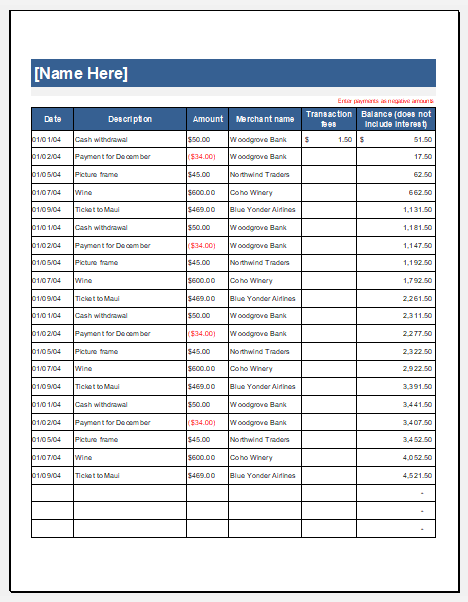
A credit card log template is designed to simplify financial tracking by organizing all transactions in a structured and easy-to-read format. It allows users to record each purchase, payment, fee, and interest charge in real time, ensuring that no expense goes unnoticed. With built-in calculations in digital formats like Excel, the template can automatically update the running balance, total spending, and remaining credit limit. This functionality helps users clearly understand their financial position at any given time and ensures better control over credit card usage.
Conclusion
Credit cards are powerful financial tools when used wisely. However, their true benefit is only realized through responsible usage and proper tracking. A credit card log template plays a vital role in maintaining financial discipline, avoiding unnecessary debt, and ensuring better control over personal or business finances.
Here we have a template created by our team to simplify credit card tracking and financial management. It is designed with a clean and user-friendly layout so that anyone can easily record and monitor their transactions.
File: Excel (.xlsx) -Size 10 KB
- Children’s Daily Activity Reward Sheet
- Winter Clothing & Gear Budget Sheet
- Winter Utility Expense Template
- Fuel & Equipment Sheets
- Monthly Attendance Sheet for Employees
- Student Entry & Exit Log
- Gantt Chart for Smaller Projects
- Behavior Log of Child for Schools
- Loan Repayment Tracker
- Product Sales Tracker Template
- Debit Memo Template for Excel
- Winter Attire Inventory
- Financial Projections Worksheet
- Employee Absence Tracker
- Weekly Sales Report Template
← Previous Article
Restaurant Food Inventory TemplatesNext Article →
Profit and Loss Statement Template