Business Model Canvas
Alexander Osterwalder, a renowned Swiss author and business theorist, introduced several advanced concepts in business modeling, among which the Business Model Canvas gained worldwide recognition. Following the success of his work, many specialized canvases emerged, each designed to address specific business niches and solve diverse challenges across different industries.
The Business Model Canvas is used by businesses and organizations to develop a new business model from scratch or refine an existing one. It provides a visual framework that allows people to analyze a company’s infrastructure, value offerings, customer segments, and other key components. Osterwalder studied various business models and consolidated them into a single reference framework. This makes it easier for businesses to use the canvas as a guide when designing or adapting a model for their organization.
Using a Business Model Canvas is both creative and effective. It allows teams to visualize, discuss, analyze, and develop the key elements of a business. During discussions, board markers or sticky notes can be used to share and organize collaboratively. Its simplicity and visual appeal have contributed to its popularity, and many organizations now use it for a variety of purposes.
The canvas is commonly applied in scenarios such as cash flow analysis, product-market fit, supply chain management, and internal communications.
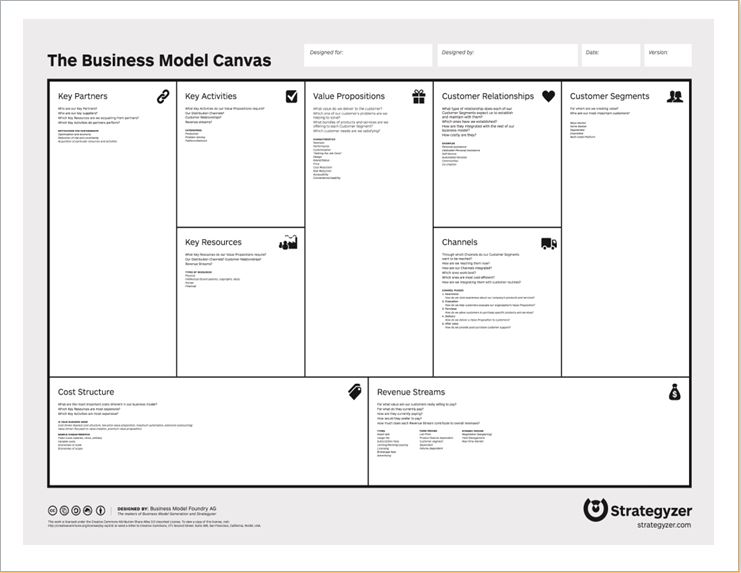
A standard Business Model Canvas outlines the infrastructure that defines the key elements of a business. This includes the resources required to execute the business model -whether financial, human, or physical. It also highlights the key activities necessary to deliver value and the key partners who support the business.
Furthermore, the Business Model Canvas provides a clear understanding of the potential customers in your industry and outlines the value or offerings provided to them. This section is particularly important because Customer Relationship Management (CRM) strategies are built upon it. To thrive in the long term, any company or organization must effectively meet the needs and expectations of its target customers. Therefore, the Value Proposition section of the Business Model Canvas plays a critical role in defining what the business delivers to its customers.
The value can be qualitative, such as the efficiency, quality, or uniqueness of a product or service, or quantitative, such as measurable benefits experienced by the customer. Additionally, the Canvas outlines the financial aspects of the business, including all types of cost structures associated with the specific business model.
Any organization or business planning to develop a model can easily use this canvas, as it includes all the essential elements needed when starting a new business or project. It is also available in software form, making it convenient for organizations to reference and apply across various business scenarios.
The above discussion illustrates a standard Business Model Canvas with all the essential components. As a template, it can be adapted to suit the specific needs of your organization or project. You may also make slight modifications to align the canvas with the standards and practices followed by your business or organization.
Here is the sample template.
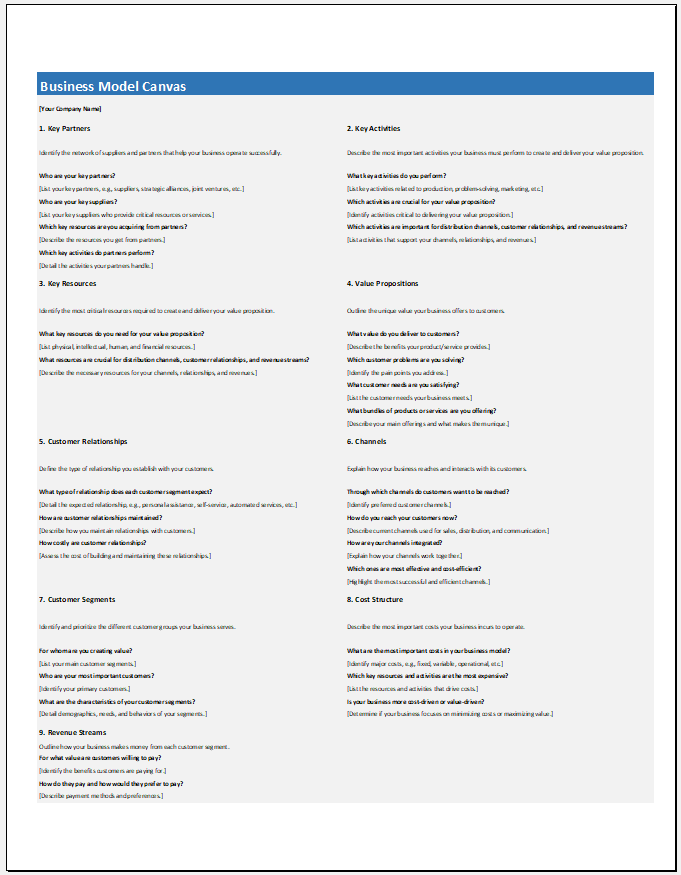
Business Model Canvas Excel Template
73 KB
#2
Another resource…
- Children’s Daily Activity Reward Sheet
- Winter Clothing & Gear Budget Sheet
- Winter Utility Expense Template
- Fuel & Equipment Sheets
- Monthly Attendance Sheet for Employees
- Student Entry & Exit Log
- Gantt Chart for Smaller Projects
- Behavior Log of Child for Schools
- Loan Repayment Tracker
- Product Sales Tracker Template
- Debit Memo Template for Excel
- Winter Attire Inventory
- Financial Projections Worksheet
- Employee Absence Tracker
- Weekly Sales Report Template
← Previous Article
Gantt Project PlannerNext Article →
Personal Weight Loss Chart Template
Leave a Reply