Petty Cash Logs
Petty cash refers to a small amount of cash that a business keeps on hand to meet its day-to-day operational expenses. This cash is usually stored in a secure locker or cash box within the business premises.
Since visiting the bank for small and frequent expenses can be time-consuming, businesses maintain petty cash to ensure smooth and uninterrupted operations. Common uses of petty cash include refreshments for meetings, small reimbursements, office supplies, and other minor expenses.
Managing petty cash effectively is an essential part of maintaining smooth day-to-day business operations. Even though the amounts involved are relatively small, they can add up over time and significantly impact overall financial accuracy. Proper management ensures that every transaction is recorded, controlled, and accounted for, helping businesses stay organized and financially transparent.
Importance of Petty Cash Management
Although the amount is small, petty cash must be properly managed just like any other financial resource of a business. This is because cash, whether large or small, is part of a company’s assets and directly affects its financial position and profitability.
Proper management ensures transparency, reduces misuse, and helps maintain accurate financial records.
What is a Petty Cash Log?
A petty cash log is a record-keeping document used to track all petty cash transactions, including cash received and cash spent.
It helps businesses maintain control over petty cash usage and ensures that all transactions are properly documented.
Keeping a proper record of petty cash transactions is essential for maintaining financial discipline within a business. A well-maintained log not only improves transparency but also helps managers easily monitor how and where small amounts of cash are being spent. This ensures better control over expenses and supports more efficient financial management.
Benefits of Using a Petty Cash Log
Using a petty cash log offers several advantages:
- It allows businesses to record and review all petty cash transactions.
- It helps prevent misuse or unauthorized spending of cash.
- It serves as an official financial record, similar in importance to a bank statement.
- It supports better planning and budgeting of small operational expenses.
- It helps track spending patterns and improve financial decision-making.
- It makes it easier to identify and resolve discrepancies between recorded and actual cash.
Petty cash logs can be maintained in different ways depending on the size of the business and its level of financial control. While some organizations prefer traditional manual record-keeping, others rely on modern digital tools for greater efficiency and accuracy. Each method has its own advantages and can be chosen based on the business’s needs and resources.
Methods of Maintaining Petty Cash Logs
Petty cash logs can be maintained in two ways:
1. Manual Method
In this traditional approach, businesses print petty cash log sheets and fill them out by hand. Entries are recorded either at the time of transaction or at the end of the day.
2. Digital Method
Modern businesses often use software, applications, or digital tools to manage petty cash. This method reduces manual effort, saves time, and minimizes human errors, resulting in more accurate financial records.
Daily Petty Cash Reconciliation
Petty cash logs are usually updated on a daily basis since petty cash is frequently used for small expenses.
At the end of each day, the recorded log is compared with the actual cash on hand:
- If both amounts match, the records are considered accurate.
- If there is a difference, the log is reviewed carefully to identify and correct the discrepancy. For example, if the physical cash is less than the recorded amount, all transactions are rechecked before closing the day’s record.
Download Template
You can download the following sample petty cash log template for your convenience and use it for your own record-keeping needs.
Preview of Template
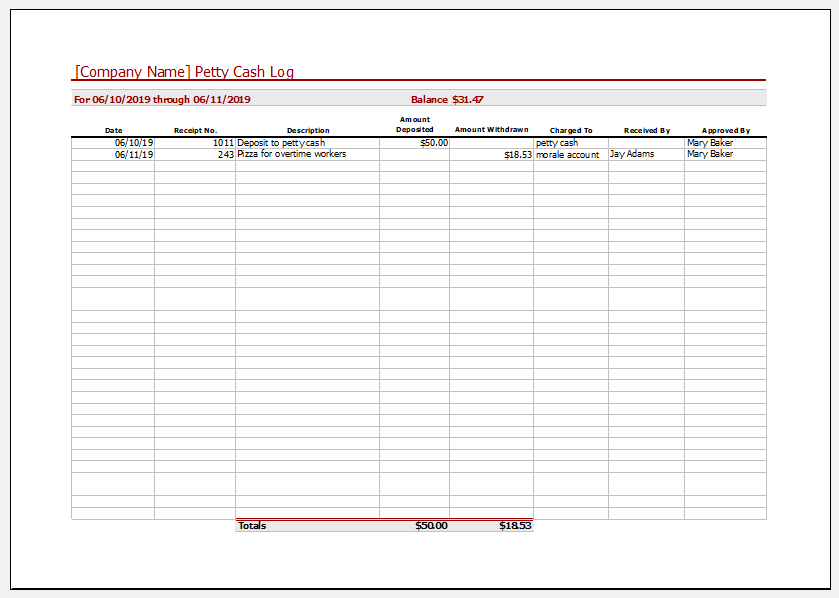
Format: MS Excel [.xlsx]
- Children’s Daily Activity Reward Sheet
- Winter Clothing & Gear Budget Sheet
- Winter Utility Expense Template
- Fuel & Equipment Sheets
- Monthly Attendance Sheet for Employees
- Student Entry & Exit Log
- Gantt Chart for Smaller Projects
- Behavior Log of Child for Schools
- Loan Repayment Tracker
- Product Sales Tracker Template
- Debit Memo Template for Excel
- Winter Attire Inventory
- Financial Projections Worksheet
- Employee Absence Tracker
- Weekly Sales Report Template
← Previous Article
Retirement CalculatorsNext Article →
Warehouse Inventories