Children Safety Checklist Template
Children are naturally curious and energetic. They love to explore their surroundings, touch new objects, and discover how things work. While this curiosity helps them learn and grow, it can also expose them to various hazards if proper safety measures are not in place. For this reason, ensuring a safe environment for children should be one of the highest priorities for parents, guardians, schools, and childcare providers.
Safety refers to protecting individuals from potential dangers, injuries, and accidents. Adults are generally able to recognize risks and avoid dangerous situations. Children, however, do not yet have the experience or judgment needed to identify many hazards. As a result, they are more vulnerable to accidents both inside and outside the home.
Many childhood injuries occur in places that seem harmless, such as bedrooms, bathrooms, kitchens, and living rooms. Common household items, electrical outlets, medicines, cleaning products, and even furniture can become sources of danger. Young children can easily fall, ingest harmful substances, pull heavy objects onto themselves, or come into contact with electrical hazards if proper precautions are not taken.
To reduce these risks, many families take steps to childproof their homes before children reach the crawling and walking stages. Sharp corners are covered, safety gates are installed, electrical outlets are protected, and dangerous items are stored out of reach. Some parents even hire professionals to assess their homes and recommend safety improvements.
One of the most effective ways to ensure child safety is by using a Children Safety Checklist. This checklist helps parents and caregivers systematically inspect their homes and identify potential hazards before accidents occur. It serves as a practical reminder of the important safety measures that should be in place to create a secure environment for children.
Bathroom Safety
Bathrooms can present several risks for young children, including drowning, slipping, and accidental poisoning. A safety checklist should help determine whether:
- Toilet lids remain closed and are fitted with safety locks.
- Buckets, tubs, or containers filled with water are kept out of children’s reach.
- Children are supervised whenever they use the bathroom.
- Bathtubs have non-slip mats to prevent falls.
- Swimming pools are protected with secure fences and locked gates.
Medicine Safety
Medicines can be extremely dangerous if accidentally consumed by children. The checklist should include questions such as:
- Are medicines stored away from children’s reach?
- Do medicine containers have child-resistant caps?
- Is the medicine cabinet locked when not in use?
- Are expired or unused medications disposed of properly?
- Are vitamins and supplements stored safely alongside prescription medicines?
Electrical Safety
Electrical hazards are a common cause of injuries in homes with young children. The checklist should verify whether:
- Electrical outlets are covered with childproof outlet protectors.
- Exposed or damaged wires have been repaired.
- Electrical systems have been inspected and maintained properly.
- Workstations and electronic equipment are inaccessible to young children.
- Power cords and appliance cables are secured and kept out of reach.
General Home Protection
A safe home environment requires attention to many small details. The checklist may include the following questions:
- Are furniture corners protected with child-safe corner guards?
- Have carpets and rugs been inspected for nails, pins, or other sharp objects?
- Are windows fitted with locks or guards to prevent falls?
- Are stair railings secure and childproof?
- Have safety gates been installed at the top and bottom of staircases?
- Are cleaning supplies and household chemicals stored in locked cabinets?
- Are heavy furniture items anchored securely to walls?
Our Template
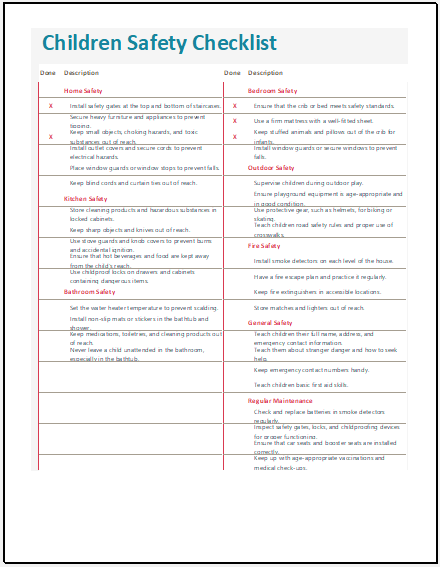
Our team has created a professionally designed Children Safety Checklist Template for Excel to help parents, guardians, and childcare providers perform thorough safety inspections. The template is easy to use, fully editable, and organized into practical categories such as bathroom safety, medicine storage, electrical safety, and general home protection.
Users can simply answer each checklist item with “Yes” or “No,” making it easy to identify areas that require attention. By using this template regularly, families can create a safer environment and reduce the risk of preventable accidents involving children.
- Children’s Daily Activity Reward Sheet
- Winter Clothing & Gear Budget Sheet
- Winter Utility Expense Template
- Fuel & Equipment Sheets
- Monthly Attendance Sheet for Employees
- Student Entry & Exit Log
- Gantt Chart for Smaller Projects
- Behavior Log of Child for Schools
- Loan Repayment Tracker
- Product Sales Tracker Template
- Debit Memo Template for Excel
- Winter Attire Inventory
- Financial Projections Worksheet
- Employee Absence Tracker
- Weekly Sales Report Template
← Previous Article
Vehicle Mortgage Payment CalculatorNext Article →
Retirement Planning Checklist Template