Proforma Balance Sheet
Managing assets is one of the most important and complex responsibilities of any business. A Proforma Balance Sheet is a financial statement that helps a business estimate its future financial position. It provides a structured projection of how assets, liabilities, and equity are expected to be managed over a specific future period.
Unlike a historical balance sheet, which reflects past performance, a proforma balance sheet focuses on forecasted financial outcomes. It allows businesses to anticipate whether they will face a cash surplus or shortage in the future. Based on this insight, management can make informed financial decisions, such as adjusting investments, controlling expenses, or arranging external financing.
In simple terms, a proforma balance sheet summarizes a company’s projected financial position after considering planned transactions and expected changes in financial statements.
Purpose of a Proforma Balance Sheet
Businesses prepare proforma balance sheets to gain better control over their financial planning and asset management. By forecasting financial outcomes, companies can make strategic decisions that improve long-term performance and stability.
A proforma balance sheet is usually prepared when a business needs to evaluate future scenarios such as expansion, investment, restructuring, or launching a new project. It helps estimate future income, expenses, and financial position based on assumptions derived from current financial data.
This statement ensures that all financial figures are properly categorized and clearly presented, including any expected deviations from current performance. It models future transactions such as capital investments, operational changes, expected revenues, and tax obligations. These projections typically focus on net cash flow, net profit, and overall financial sustainability.
Lenders and investors also use proforma balance sheets to assess risk and evaluate a company’s ability to meet debt obligations. It is also commonly prepared for startups to present financial forecasts to potential investors and stakeholders.
Components of a Proforma Balance Sheet
A well-prepared proforma balance sheet includes all expected financial elements of a business. These are generally divided into assets, liabilities, and equity.
1. Long-term Assets (Non-current Assets)
Long-term assets represent resources that a business expects to use for more than one year. These include land, buildings, machinery, vehicles, and equipment.
The value of these assets is typically calculated by deducting accumulated depreciation from their original cost. These assets play a key role in generating long-term revenue and supporting business operations.
2. Short-term Assets (Current Assets)
Short-term assets are resources that are expected to be converted into cash within a short period, usually within one year. These include cash in hand, bank balances, accounts receivable, inventory, and short-term investments.
Accounts receivable represent money owed to the business from customers or other income sources. These assets ensure that the business maintains sufficient liquidity for day-to-day operations.
3. Liabilities
Liabilities refer to the financial obligations that a business is required to pay in the future. These include salaries payable, loan repayments, taxes, mortgages, and other outstanding expenses.
Liabilities are generally categorized into current liabilities (short-term obligations) and long-term liabilities (long-term financial commitments). Proper estimation of liabilities is essential for maintaining financial stability and avoiding cash flow problems.
4. Equity (Owner’s Capital)
Equity represents the owner’s residual interest in the business after deducting liabilities from assets. It includes invested capital, retained earnings, and any additional reserves. In a proforma balance sheet, equity reflects the expected financial value owned by shareholders in the future.
Importance of a Proforma Balance Sheet
A proforma balance sheet plays a vital role in financial planning and decision-making. It helps businesses:
- Evaluate future financial health
- Plan investments and expansion strategies
- Manage cash flow effectively
- Attract investors and secure loans
- Identify potential financial risks in advance
It is an essential tool for both new and established businesses for strategic forecasting and financial control.
Free Excel Template
Our Proforma Balance Sheet Template for Excel is designed to simplify financial forecasting and improve accuracy in business planning. It provides a clear and structured format for entering projected figures for assets, liabilities, and equity. The template automatically organizes financial data, making it easier to analyze future financial positions without complex manual calculations.
It is suitable for startups, small businesses, and established organizations that want to plan growth, manage risk, and present financial projections to investors or stakeholders. With a user-friendly layout and logical structure, our template helps ensure that financial forecasting is both efficient and reliable.
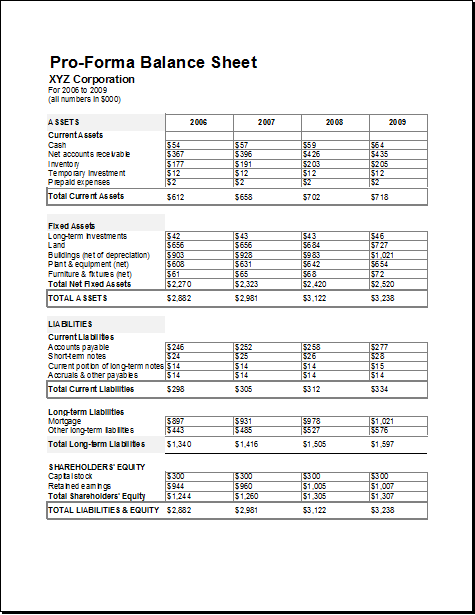
Download your file below.
- Children’s Daily Activity Reward Sheet
- Winter Clothing & Gear Budget Sheet
- Winter Utility Expense Template
- Fuel & Equipment Sheets
- Monthly Attendance Sheet for Employees
- Student Entry & Exit Log
- Gantt Chart for Smaller Projects
- Behavior Log of Child for Schools
- Loan Repayment Tracker
- Product Sales Tracker Template
- Debit Memo Template for Excel
- Winter Attire Inventory
- Financial Projections Worksheet
- Employee Absence Tracker
- Weekly Sales Report Template
← Previous Article
Funds Tracking Balance SheetNext Article →
Projected Balance Sheet
Leave a Reply