Expected Commercial Value Calculator
Making the right investment or project decision requires more than intuition. Businesses and investors need a reliable method to evaluate whether a project, product, or opportunity is likely to generate sufficient returns compared to the costs and risks involved. This is where an Expected Commercial Value (ECV) Calculator becomes useful.
Expected Commercial Value is a financial evaluation method used to estimate the potential value of a project while considering both the probability of success and the costs associated with development, launch, and commercialization. By using an ECV Calculator, decision-makers can compare opportunities objectively and determine whether a project is worth pursuing.
Organizations often use ECV analysis when evaluating new products, research and development initiatives, technology investments, and other business ventures where future outcomes are uncertain. Instead of relying on guesswork, the calculator provides a structured approach to assessing the financial attractiveness of an opportunity.
What Is Expected Commercial Value?
Expected Commercial Value (ECV) is a measurement used to estimate the financial worth of a project after accounting for its chances of technical and commercial success. It combines projected revenues, development expenses, launch costs, and risk factors into a single value that helps businesses make informed decisions.
The ECV method recognizes that not every project will succeed. Therefore, it adjusts the projected financial return based on the probability that the project will successfully reach the market and generate expected revenues.
A positive ECV generally indicates that a project has the potential to create value, while a negative ECV may suggest that the risks and costs outweigh the expected benefits.
Information Required for ECV Calculation
To calculate the Expected Commercial Value, the following information is typically required:
- Present Value (PV) of expected future earnings
- Probability of Commercial Success (Pcs)
- Probability of Technical Success (Pts)
- Launch and Marketing Costs (C)
- Development Costs
The formula used is:
Expected Commercial Value (ECV) = [(PV × Pcs – C) × Pts] – Development Cost
Different organizations may modify the formula slightly to suit their evaluation methods. However, these core components are commonly used in most ECV analyses.
How the Expected Commercial Value Calculator Works
Our team has created an easy-to-use Excel-based Expected Commercial Value Calculator that automates all calculations and helps users evaluate projects quickly and accurately.
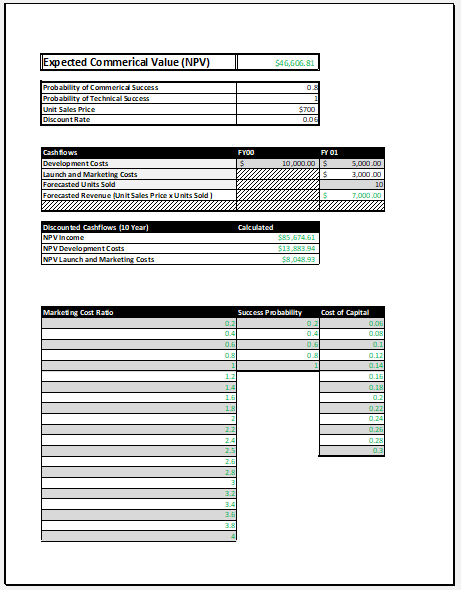
The template begins with an input section where users enter key assumptions, including the Probability of Commercial Success, Probability of Technical Success, Unit Sales Price, and Discount Rate. These values are used throughout the workbook to calculate projected financial outcomes.
The template also includes a detailed 10-year cash flow forecast. Users can enter:
- Development Costs
- Launch and Marketing Costs
- Forecasted Units Sold for each year
Based on the unit sales price and forecasted sales volume, the spreadsheet automatically calculates projected revenue for each year.
Using the specified discount rate, the calculator then determines the Net Present Value (NPV) of future income, development costs, and launch and marketing expenses. These discounted values provide a more realistic estimate of future financial performance by accounting for the time value of money.
After calculating the relevant NPV figures, the template automatically applies the Expected Commercial Value formula to produce the final ECV result. This allows users to quickly assess whether a project is likely to create commercial value after considering costs and risks.
The worksheet also includes a sensitivity analysis section that enables users to examine how different combinations of marketing cost ratios, success probabilities, and costs of capital can affect the project’s value. This feature helps decision-makers understand potential outcomes under various scenarios and make more informed investment decisions.
Functionality of This Excel Template
Our team has created an Expected Commercial Value Calculator in Excel to make the calculation process simple and organized. The template includes three sheets: Instructions, Input, and Output.
The Input sheet is the main working area of the template. At the top, users can enter the Probability of Commercial Success, Probability of Technical Success, Unit Sales Price, and Discount Rate. These values are used automatically in the calculations.
The template also includes a 10-year cash flow section from FY00 to FY10. Users can enter Development Costs, Launch and Marketing Costs, and Forecasted Units Sold for each year. Once the unit sales price and forecasted units are entered, the sheet automatically calculates Forecasted Revenue by multiplying the unit sales price by the number of units sold.
Below the cash flow section, the template calculates important discounted values, including NPV Income, NPV Development Costs, and NPV Launch and Marketing Costs. These values are then used to calculate the final Expected Commercial Value.
The Output sheet presents the result in a clean visual format. It includes a line chart that compares Development Costs, Launch and Marketing Costs, and Forecasted Revenue over the 10-year period. This helps users quickly understand how costs and revenue change over time. The final Expected Commercial Value result is also displayed below the chart.
The template also includes a sensitivity-related area in the Input sheet with Marketing Cost Ratio, Success Probability, and Cost of Capital values. These values can help users analyze how changes in cost, success chances, and discount rates may affect the project’s expected value.
Benefits of Using This Template
Using this Expected Commercial Value Calculator offers several advantages:
- Saves time by automating complex calculations
- Reduces the risk of manual calculation errors
- Provides a structured framework for project evaluation
- Incorporates risk and probability into decision-making
- Calculates discounted cash flows automatically
- Supports long-term financial planning
- Helps compare multiple investment opportunities objectively
Final Thoughts
Before committing resources to a new project or investment, it is important to understand its potential financial return and associated risks. Our Expected Commercial Value Calculator simplifies this process by combining revenue projections, cost estimates, probabilities of success, and discounted cash flow analysis into a single Excel template.ply enter your project assumptions, and the calculator will automatically generate the Expected Commercial Value, helping you make more confident and data-driven business decisions.
Here is your template to download.
Format: MS Excel [.xlsx]
File Size: 98 KB
- Business Startup Cost Estimator
- Home Construction Cost Estimator
- Kitchen Remodel Budget Calculator
- Personal Assets and Debts Calculator
- Power Consumption Calculator
- Payroll Calculator Template for Excel
- Food Fat Percentage Calculator Template
- Total Cost of Ownership Calculator Template
- Real Estate Commission Calculator
- Retirement Calculators
- Vehicle Loan Payment Calculator
- Year-end Tax Planning Calculator
- Sales Probability Assessment Calculator
- Travel Expense Calculators
- Sales Commission Calculators
- Mortgage Loan Calculator
- Simple Loan Calculator Template
- Net Present Value Calculator
← Previous Article
Balloon Loan Payment CalculatorNext Article →
Home Equity Loan Calculator